
EPR in Poland for Amazon sellers: BDO, packaging, electronics and batteries in 2026
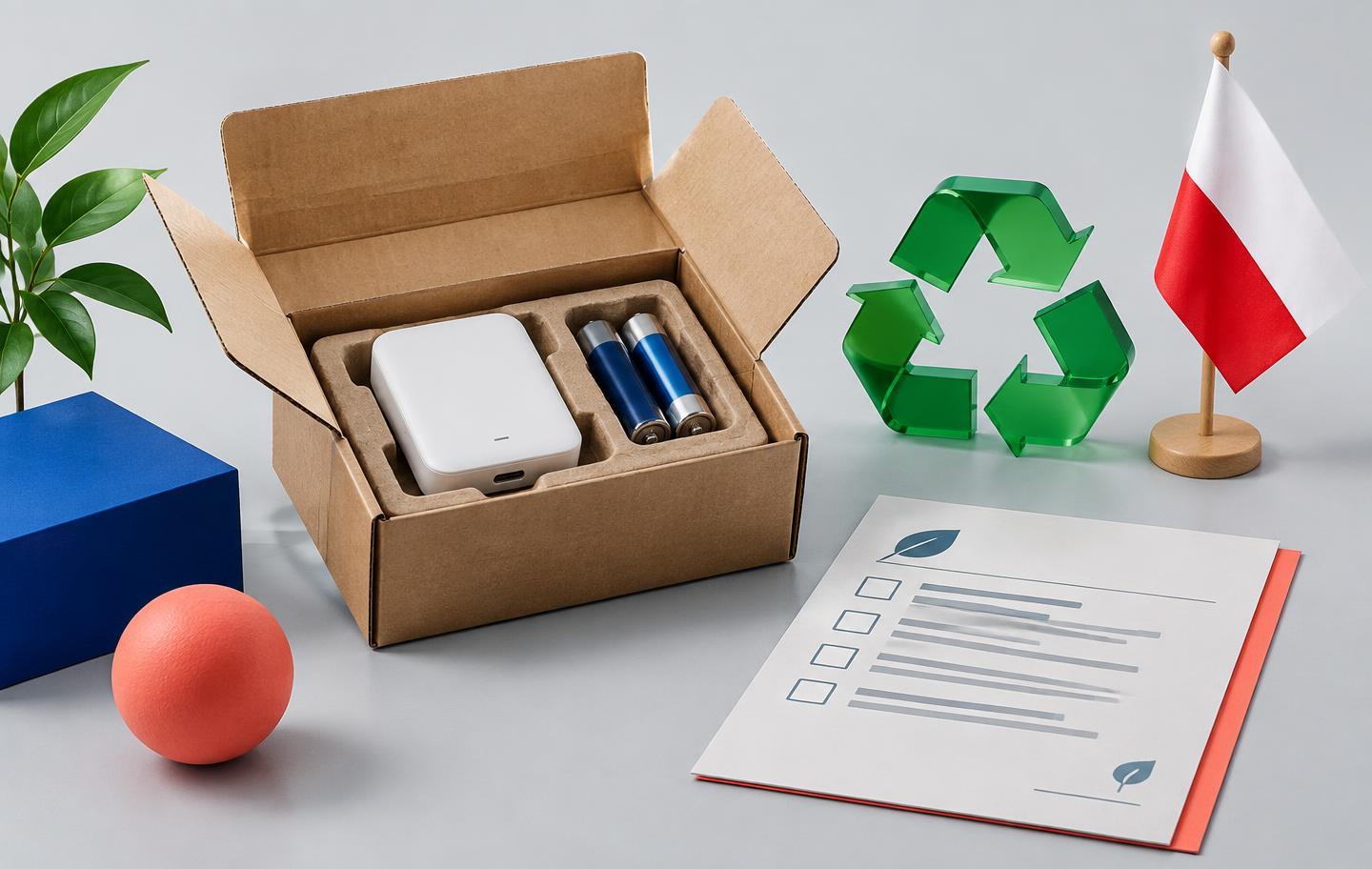
An active Seller Central listing does not prove that environmental obligations have been fulfilled. Amazon’s acceptance of a product does not replace registration, weight records or financing waste management. EPR is determined by the rules of each country and product stream, not simply by account settings.
In Poland, the starting point is identifying your company’s role and the correct scope of its BDO registration. One product can trigger separate packaging, electrical-equipment and battery obligations. Sharing a register does not mean these are a single compliance process.
This guide separates legal duties from marketplace checks and explains how to assess FBM, FBA and cross-border sales. It takes account of PPWR’s general application from 12 August 2026 without treating requirements with later deadlines as already applicable.
1. Identify your role before looking for an EPR number
An EPR producer is not necessarily a factory. Duties can apply to an importer, the first supplier in a market or a distance seller. Check the definition separately for packaging, equipment and batteries.
A Polish reseller does not automatically become the producer of every product it sells. Domestic resale differs from importing from China, acquiring goods from another EU country or selling under your own brand. Additional shipping packaging needs a separate assessment from the original product packaging.
Document who buys, imports, packs and sells, the destination country and whether the recipient is an end-user. The amazon.pl domain or a warehouse address does not by itself determine every obligation.
2. BDO: registration must match your actual activities
If your activities require registration, obtain it before starting those activities. Applications are submitted electronically through BDO and must cover the relevant sections and product types. A number without the correct scope is not proof of compliance.
Check packaged products, electrical equipment and batteries separately where your company has the relevant role. The registration number must appear on documents connected with the activities covered by the Waste Act’s applicable provisions.
Product and packaging weight records are not the same as waste records or waste transfer documents. Waste-generator duties depend on the waste your business actually generates; producer status does not automatically require a waste transfer document for each parcel.
3. Packaging: measure components, not just the carton
Assess retail boxes, inserts, films, grouped packaging and transport components that meet the packaging definition. Reporting needs weights by material and a correct allocation of responsibility.
Carton purchase invoices rarely tell the whole story. Stock can remain unused, be exported or serve other purposes. Reports should reflect actual flows within the obligation, not every packaging item purchased.
With PPWR applying, reassess its producer definitions for different packaging categories. Responsibility for empty transport, service and primary-production packaging does not always lie with the business that fills it. Avoid assigning every component using a single rule.
4. FBA and FBM: logistics do not transfer EPR automatically
With FBM, you organise dispatch and normally have access to your own packing-material data. You still need to determine which components and supplies fall within your duties and in which country.
FBA means Amazon stores and dispatches goods. It does not automatically transfer your product, retail-packaging or battery obligations to Amazon. Assess separately the packaging added by the fulfilment operator and packaging used for inbound transport.
Where inventory moves between countries, retain transfer data and identify the market of final supply. Do not assign all sales to Poland merely because some inventory is stored in a Polish fulfilment centre.
5. Electronics and batteries: three streams in one listing
A rechargeable lamp or electronic toy may require parallel packaging, equipment and battery assessments. An embedded battery remains relevant even when it is not sold separately.
For equipment, check category, producer status, collection and treatment financing and applicable information, marking and take-back duties. Assess distributor duties separately from producer duties.
For batteries, consider Regulation (EU) 2023/1542, including Chapter VIII applying from 18 August 2025. A battery passport is not required for every battery in 2026: from 18 February 2027 it covers specified categories, including LMT batteries, industrial batteries above 2 kWh and electric-vehicle batteries.
6. Registration is the start: financing and reporting
After registration, arrange fulfilment of each stream’s obligations. A contract with a recovery organisation or another authorised provider can support compliance, but its scope and your data must reflect actual activities.
The annual report on products, packaging and waste arising from them is generally submitted through BDO by 15 March for the preceding calendar year. For 2026 data, the reference deadline is therefore 15 March 2027; required sections depend on your company’s duties.
Provider reporting dates, payments and other obligations can have different deadlines. Maintain a separate calendar and submission receipts instead of treating one annual BDO login as complete compliance.
7. Up to one tonne of packaging: relief is not deregistration
Polish rules provide a de minimis relief route where packaging placed on the market does not exceed 1 Mg in a year. It is not a blanket small-shop EPR exemption or automatic relief based on a low order count.
Check statutory conditions, the relief’s scope, available aid allowance and required documents. Relief from selected packaging duties does not replace BDO registration, records or annual reporting, and does not extend to equipment and batteries.
Do not assume a late application will be accepted or that exactly one tonne removes formalities. Confirm the procedure with the competent authority before the deadline and keep your weight calculations.
8. Amazon checks: verify each country and category
Law and Amazon’s verification process are separate layers. You may have statutory duties before Seller Central asks for a number; the platform may also request additional evidence or explanations.
Batteries have a specific official notice: on 30 July 2025, Amazon identified 18 August 2025 as the final battery-regulation compliance verification deadline and BDO as the Polish register. The notice also covers products containing batteries or accumulators. This is not a deadline for every EPR stream; check your account for current status and submission instructions.
Do not treat German LUCID or French UIN identifiers as Polish compliance. Check Amazon’s current notice for the specific country, category, identifier, legal-entity details and deadline. A BDO number does not replace foreign registration.
PPWR Article 45(4) establishes online-platform duties to obtain producer-registration information and a compliance self-certification before allowing specified offers. It does not prove a single uniform blocking date for all Polish listings. We do not state such a date without a confirmed Amazon notice for the relevant scope.
9. PPWR from August 2026: not every requirement starts together
Regulation (EU) 2025/40 generally applies from 12 August 2026. Separate EPR from packaging product conformity and determine whether you are an EPR producer, manufacturer, importer or distributor under the relevant provisions.
A foreign distance seller within Article 3(1), point 15(d), must assess appointment of an EPR authorised representative in the destination country under Article 45(3). This can include professional end-users, not only consumers.
Recyclability grades and empty-space limits have later deadlines and dependencies specified in the regulation. Do not present the 50% empty-space limit as universally applying to parcels from August 2026. National EPR reform proposals must likewise be distinguished from published, applicable legislation.
10. Example: a rechargeable lamp sold through FBA
A Polish business imports a rechargeable lamp from outside the EU, sends stock to Amazon and sells to customers in Poland and Germany. It assesses Polish equipment, battery and packaging duties and separately checks German requirements.
It records equipment weight in the correct category, battery data and packaging-component weights. It establishes responsibility for materials added by Amazon and distinguishes stock transfers from supply in the destination market.
It updates records when the product or supplier changes. A SKU cannot retain the same material profile when a new version uses different packaging or a larger battery.
11. Data to collect before reporting
An Amazon report is a starting point, not a ready-made environmental filing. Link it to product and packaging records, and assess corrections, returns, exports and transfers under the applicable rules rather than automatically deducting every return.
- Selling entity, destination country, date and fulfilment model.
- SKU or ASIN linked to the current product specification.
- Packaging-component weights by material and supplier evidence.
- Equipment category and weight, plus relevant battery data, including embedded batteries.
- Registrations, contract scopes, representative mandates and submission receipts.
- Correction evidence and documented responsibility for every stream.
12. Common seller questions
Does Amazon handle EPR for me? Do not assume so simply because you use FBA. Any service needs a confirmed country and stream scope; duties outside it still need to be fulfilled.
Does one Polish BDO number cover the EU? No. Assess each country and stream separately, even with one Amazon account.
Does one small battery supplied with a product matter? Yes. Included and embedded batteries need to be considered when assessing the product.
What if earlier sales lacked the correct registration? Reconstruct data from the start of the applicable period and obtain advice on registration and outstanding obligations. Later registration does not automatically erase earlier liabilities.
13. How EPRPilot helps organise Amazon compliance
EPRPilot organises product and packaging data, registrations and deadlines by country and stream. Teams can connect sales information to material weights and identify missing evidence or outdated specifications.
The tool does not replace a legal assessment of your role or an authority’s decision. Organised data makes reporting and evidence preparation easier than reconstructing records after a marketplace notice.
Sources and scope of this guide
This is general information, not individual legal advice. Reference date: 6 October 2026. Duties depend on your role, product, sales destination and applicable rules. Consult current consolidated Polish legislation and amendments; verify Amazon notices in Seller Central for your own account, country and category.
- BDO — official portal and guidance
- Amazon — official battery notice dated 30 July 2025 (Polish)
- Polish Waste Act of 14 December 2012
- Polish Packaging and Packaging Waste Management Act
- Polish Waste Electrical and Electronic Equipment Act
- PPWR — Regulation (EU) 2025/40
- Batteries — Regulation (EU) 2023/1542
Can you produce a Declaration of Conformity in 10 days?
See how EPRPilot keeps packaging data, EPR registrations and deadlines for all 27 EU markets in one place.