
EUDR in Poland: penalties of up to 4% of turnover — what are the obligations?
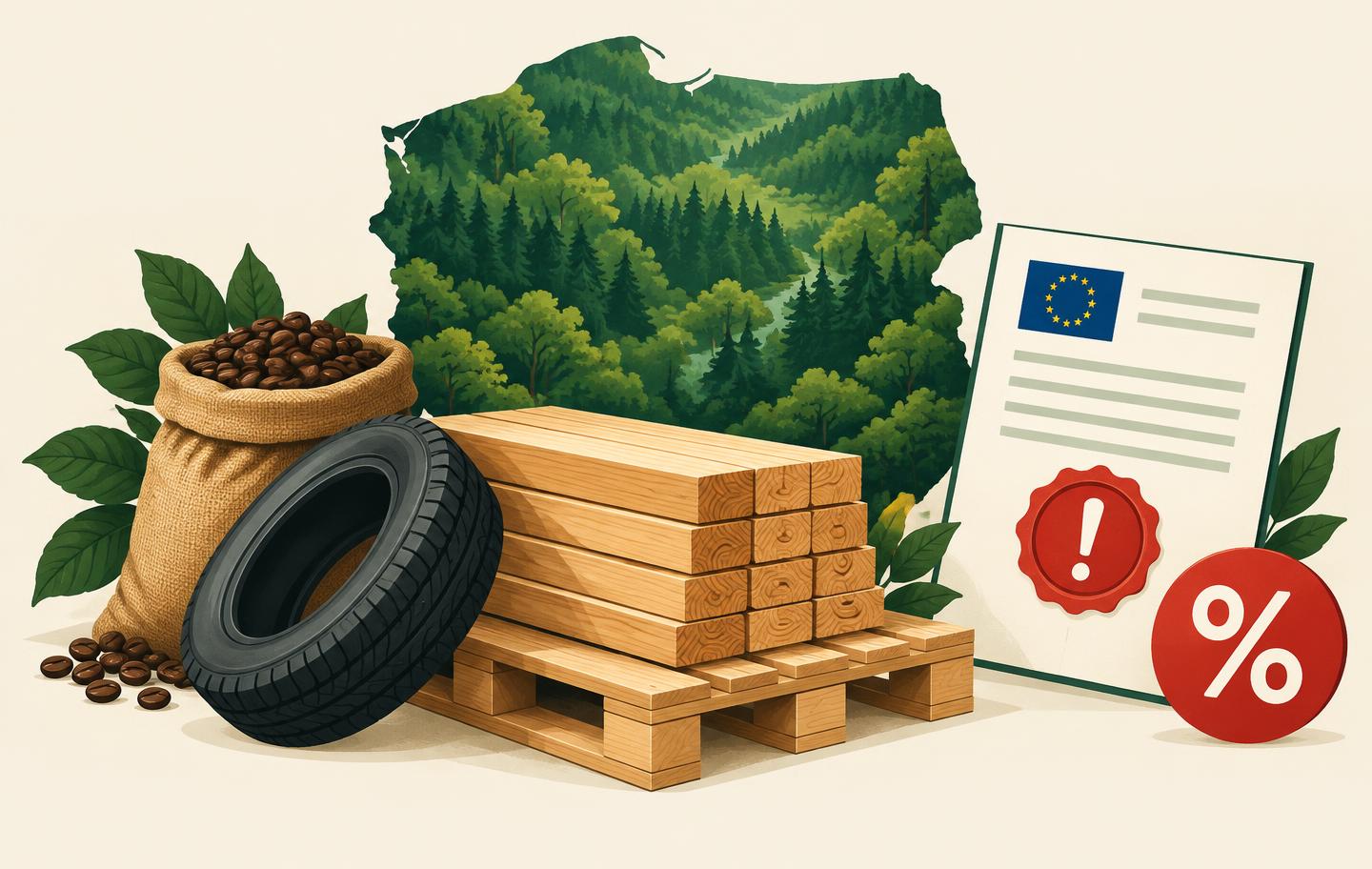
Many businesses still do not realise they may fall under the EUDR rules. In practice, the obligations can cover not only importers of wood, coffee or cocoa, but also furniture producers and distributors, paper goods makers, seasonal products and components containing wood or rubber.
Regulation (EU) 2023/1115 applies directly, but the forthcoming Polish act will decide which authority carries out inspections, how long they take, who bears the costs and which penalties are imposed. The draft (UC101) creates no new substantive duties — it builds the national enforcement system.
This article explains the obligations businesses must meet, who will supervise companies in Poland, the sanctions the draft provides and when the deadlines start. Reference date: 19 October 2026.
1. EUDR is not only about wood importers
EUDR covers cattle, cocoa, coffee, oil palm, rubber, soya and wood, plus specified products made from them. The scope depends on Annex I of the regulation and the product's CN code, not simply on a commodity appearing in the composition.
In practice this means the duties can apply to furniture producers and distributors, paper goods makers, seasonal products or components containing wood and rubber. Furniture, paper, e-commerce and manufacturing businesses often fall under the rules without knowing it.
The first step is always an inventory: list your products and their CN codes, then check them against the current Annex I. Do not assume your industry is out of scope.
2. What does the draft Polish act (UC101) change?
The draft act protecting the Polish market from deforestation-linked products creates no new obligations, because these flow directly from the EU regulation. What the act establishes is the national enforcement system: control authorities, inspection procedures and penalties for breaching EUDR requirements.
The draft has already been revised several times — successive versions appeared in the Government Legislation Centre in April, July and August 2026. Details on penalties and procedures may still change before the act reaches parliament.
Waiting for the final text is not a good strategy, though. The substantive duties come from the regulation and start applying on the relevant date, while collecting supplier data and building records takes months, not days.
3. What are the obligations? Due diligence
Businesses covered by EUDR must implement a due diligence procedure before placing a product on the market or exporting it. In practice this covers four areas.
- Gathering information on the product and supplier, including origin data for the raw material.
- Assessing the risk of deforestation and forest degradation, and of breaching the laws of the country of production.
- Mitigating the risk where the assessment indicates possible non-compliance.
- Submitting a due diligence statement (DDS) in the EUDR Information System.
4. Who will supervise businesses in Poland?
The draft Polish act divides competences between several authorities. The Veterinary Inspection would cover cattle, the Trade Quality Inspection of Agri-Food Products (IJHARS) cocoa, coffee, soya and palm oil, and the Environmental Protection Inspection (IOŚ) wood and rubber.
In practice, a single company may be inspected by different authorities depending on the flow of goods. An importer with a broad product portfolio should know each authority's competence for every stream, not only the main assortment.
5. What penalties apply for non-compliance?
The draft act provides for severe sanctions. The range of proposed measures shows that EUDR enforcement will not rely on financial penalties alone.
- Administrative fines based on the company's turnover.
- Fines whose maximum level must be at least 4% of annual EU-wide turnover — the regulation requires this for legal persons, and the act will define how they are measured.
- Seizure and confiscation of goods.
- A ban on placing products on the market.
- A ban on exporting.
- Temporary exclusion from public procurement.
- Temporary disqualification from grants and public funds.
6. Is your company covered by EUDR?
In practice, verify whether the products you sell or import contain wood, paper, rubber, coffee, cocoa, soya, palm oil or derivatives of them. Many businesses in furniture, paper, e-commerce and manufacturing may fall under the new duties without realising it.
If your product list gives a reason, work through the steps below for each product group.
- Check your products' CN codes against Annex I of the regulation.
- Map your suppliers and establish where the raw material comes from in each flow.
- Identify your company's role: upstream operator, downstream operator or trader.
- Check the application date for your company size and product.
- Plan supplier data, record-keeping and due diligence documentation.
7. Timelines: when does EUDR start applying?
EUDR starts applying to large and medium-sized businesses on 30 December 2026, and to most micro and small businesses on 30 June 2027. Note the exception: for micro and small businesses, products already covered by the existing EUTR remain on the earlier date of 30 December 2026.
Timelines also concern products added to the scope by the delegated regulation — for those, the Commission indicates 30 December 2027. When establishing your date, check both company status and the particular product, plus transitional provisions.
Obtaining geolocation from suppliers, assessing risk and building records takes time — usually months of work. Start preparing now rather than in December 2026.
8. How to prepare for EUDR in Poland?
The EUDR package available through EPRPilot organises the preparation: a decision tree for identifying your company's role, a due diligence procedure, a supplier letter and questionnaire, a delivery register, a risk-assessment sheet and an inspection-readiness checklist. It is a ready set of documents to fill in with your company's data.
This article is general information, not individual legal advice. The UC101 draft may still change — follow its status at the Government Legislation Centre. For decisions on specific products, check the current Annex I, transitional provisions and national requirements.
Can you produce a Declaration of Conformity in 10 days?
See how EPRPilot keeps packaging data, EPR registrations and deadlines for all 27 EU markets in one place.