
EPR in Czechia and Slovakia: packaging, WEEE and batteries before your first sale
Dieser Artikel ist derzeit nur auf Englisch verfügbar.
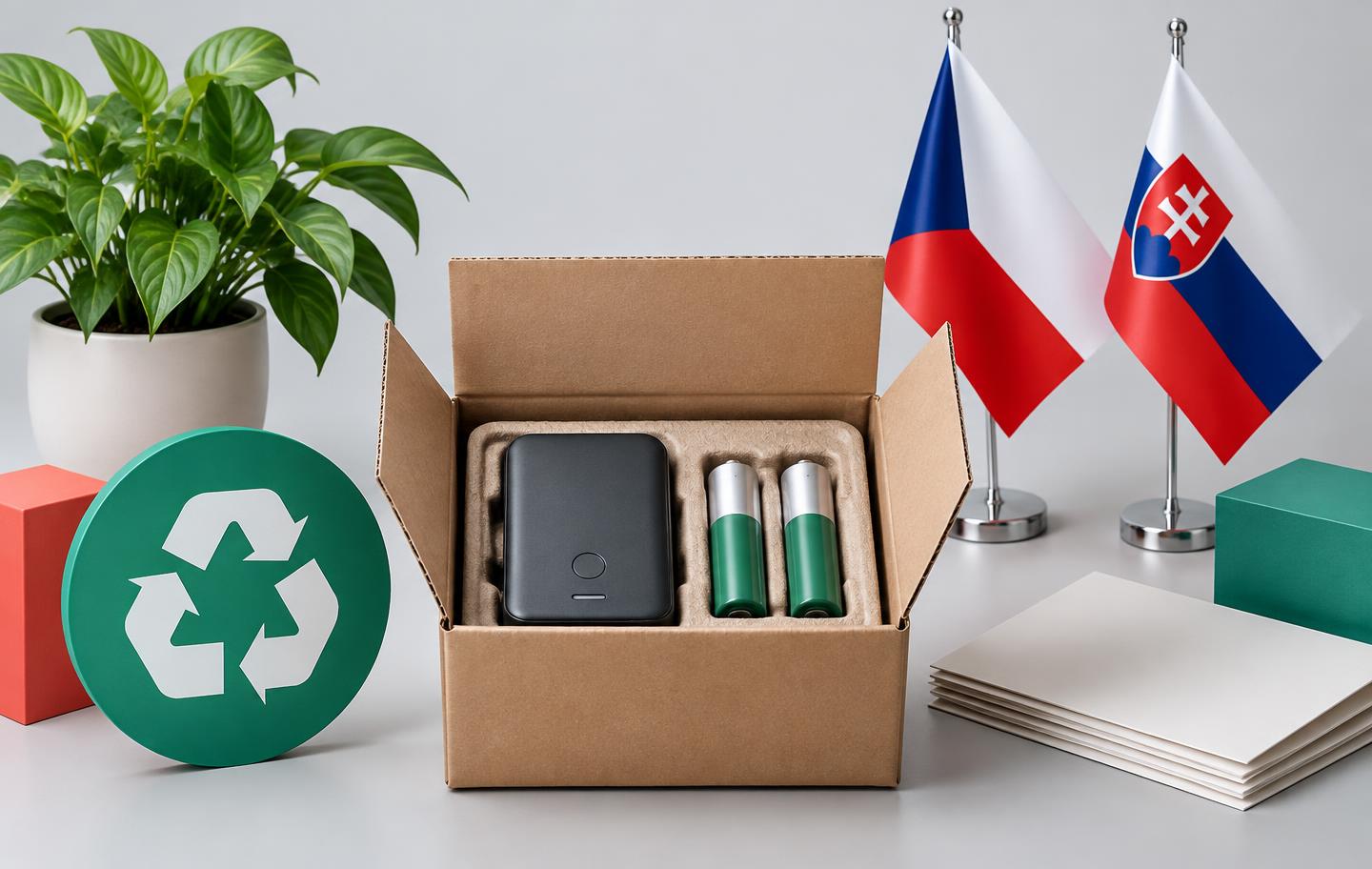
A translated online store, local currency and a courier contract are not the whole checklist for entering Czechia or Slovakia. Cross-border sales can also make your company responsible for the packaging and products that will eventually become waste in the destination country.
EPR — Extended Producer Responsibility — is assessed by market and by product stream. Polish BDO registration, a VAT number or participation in a Polish recovery organisation does not replace Czech or Slovak compliance. One parcel can create three separate workstreams: packaging, electrical equipment and batteries.
This guide explains how to organise that assessment before launching sales. It reflects the general application of PPWR from 12 August 2026, without assuming that every later packaging requirement is already in force.
1. Start with the sales model, not the location of your warehouse
In EPR legislation, a producer is not necessarily the factory that manufactured the goods. The term can cover an importer, a company first supplying products in a country or a foreign distance seller supplying end-users. The applicable definition differs between packaging, WEEE and batteries.
Map the actual transaction: who sells, who receives the goods, who imports them, who adds the shipping packaging and whether the recipient resells the product or uses it. A warehouse abroad, marketplace fulfilment or a distributor does not automatically settle these questions.
Do not equate B2B with an exemption. A Czech or Slovak business buying supplies for its own use can be an end-user rather than a reseller. PPWR expressly distinguishes professional end-users, so the recipient's role matters as much as its business status.
2. Czech packaging: understand EKO-KOM and the reporting scope
Czech packaging obligations are rooted in Act No. 477/2001 Coll. A widely used collective-compliance route is a contract with the authorised packaging company EKO-KOM. Its services address specified packaging take-back and recovery obligations; it is not a single registration covering electronics and batteries as well.
EKO-KOM published new reporting methodologies effective from 12 August 2026 to reflect PPWR. These include a methodology identifying obligated producers and an updated quarterly statement methodology. A company using an old reporting model should therefore reassess who is responsible for each packaging flow.
In particular, empty service, transport and primary-production packaging can require a different allocation of obligations from packaged retail goods. Confirm the treatment with the relevant organisation or representative instead of automatically assigning every box to the seller that fills it.
3. Slovak packaging: registration and an OZV are different steps
Slovakia's national framework is Act No. 79/2015 Coll. on Waste. Producers of designated products are covered by stream-specific requirements, including the relevant register. Packaging registration should be resolved before placing packaging on the Slovak market.
An OZV — an organisation of producer responsibility — performs collective obligations within its authorised scope. A contract with an OZV and an entry in the relevant producer register serve different purposes: do not treat a signed commercial agreement as proof that every registration formality is complete.
Foreign businesses also need to assess the Slovak authorised-representative rules. Verify the representative's mandate, the streams it covers, who submits information and how you receive confirmation of registration. A packaging mandate should not be assumed to cover WEEE or batteries.
4. Foreign distance sellers: check local representation
Article 45(3) PPWR requires producers within Article 3(1), point 15(d), established in another Member State or a third country to appoint an authorised representative for EPR in the Member State where they first make packaging or packaged products available. This category covers direct distance sales to end-users, including professional end-users.
For sales into Czechia and Slovakia, assess the need for a representative established in each destination country. This EPR role is distinct from a representative handling packaging product-conformity tasks. Do not assume that a tax adviser, logistics provider or existing VAT representative has the necessary EPR mandate.
Check the rules currently applicable to the exact stream and sales model, including any adopted amendments. Announcements or proposals to simplify representation are not themselves a legal exemption.
5. Small volumes: why a threshold is not a complete answer
National rules may offer relief for small quantities of packaging, but the scope and conditions differ. A threshold can affect selected financing or reporting obligations without removing every registration, evidence or product-conformity requirement.
Do not transfer a Czech small-producer rule to Slovakia, and do not infer that ten parcels are automatically exempt. Establish what the current national provision actually waives, how quantities and any turnover condition are calculated, and how it interacts with PPWR's distance-selling rules.
Until that assessment is documented, keep material and weight records from the first shipment. They are the evidence needed to establish whether a volume-based relief is available at all.
6. WEEE: electronics need their own compliance path
Electrical and electronic equipment falls under a separate system. Czechia's framework includes Act No. 542/2020 Coll. on End-of-Life Products; Slovakia regulates WEEE through its Waste Act. Packaging participation alone does not finance or document the equipment's end-of-life obligations.
The WEEE Directive requires a seller established in one Member State and selling electrical equipment by distance directly to users in another Member State to appoint an authorised representative there. For other establishment models, check the relevant national implementation.
Classify equipment before preparing reports. Relevant data can include category, units and equipment weight, together with take-back and consumer-information duties. Do not report the gross parcel weight as the weight of the electrical device.
7. Batteries: an integrated cell still counts
A battery inside a lamp, toy or other device does not disappear from EPR. Regulation (EU) 2023/1542 covers batteries, including those incorporated into products. Its waste-battery chapter, containing producer registration and EPR rules, applies from 18 August 2025.
Assess registration in each destination market and the authorised-representative requirement for relevant foreign distance sellers under Article 56. Record the battery category, chemistry, weight and quantities in a way that can support the local reporting procedure.
Keep battery EPR separate from future battery-passport duties. From 18 February 2027, the passport requirement applies to LMT batteries, industrial batteries above 2 kWh and electric-vehicle batteries — not to every small portable battery sold online.
8. One lamp, two countries, three streams
Imagine a Polish online shop selling a rechargeable lamp directly to customers in Czechia and Slovakia. Each unit has a retail box and protective insert; the shop adds a shipping carton and paper filling.
For each country, assess the lamp under WEEE, the battery under battery EPR and each packaging component under packaging rules. Confirm responsibility for the shipping packaging separately, particularly if a fulfilment provider buys or adds it.
The compliance map is therefore two markets multiplied by three streams. It does not necessarily mean six different providers, but it does require evidence that all six areas are addressed. A single PDF saying 'EPR compliant in the EU' is not that evidence.
9. What data should your reports be built on?
For example, 1,000 parcels containing 180 g of cardboard, 12 g of plastic film and 25 g of paper filling correspond to 180 kg, 12 kg and 25 kg of those components respectively. The combined 217 kg is not a substitute for the material breakdown. Allocate the result to the correct country and period, and check whether additional packaging components are missing.
- SKU, destination country, sales date and units supplied to that market
- Packaging components: retail box, label, film, insert, mailer and filling, with each material and weight
- Equipment category and reportable equipment weight for electrical products
- Battery category, chemistry, weight and quantity, including integrated batteries
- The responsible producer, representative, organisation, registration confirmation and contract for each market and stream
- Documented corrections for returns, cancellations and changed specifications in accordance with the reporting methodology
10. Costs and deadlines: avoid a single EU-wide assumption
EPR costs can combine registration or administrative charges, representative fees, minimum contractual charges and contributions linked to material, category and quantity. Ask which items are included and whether packaging, WEEE and batteries are priced separately. VAT or OSS procedures do not replace any of these environmental duties.
EKO-KOM operates quarterly statements; other organisations and streams can have different reporting schedules. Build a country-and-stream calendar from current contracts and legal requirements rather than applying Poland's BDO deadline to all markets.
Also set an earlier internal deadline for gathering and reviewing data. The external submission date should not be the first day on which someone checks whether the product database contains battery weights.
11. PPWR: common packaging rules, not one European EPR account
Regulation (EU) 2025/40 generally applies from 12 August 2026. It harmonises packaging requirements and changes producer definitions and EPR obligations, but it does not turn registration and reporting into a single account covering every Member State.
Maintain both layers: country-specific EPR evidence and packaging-conformity documentation. Depending on your role, the latter involves technical information, conformity assessment and an EU declaration of conformity. Having a recovery-organisation contract does not prove packaging product conformity.
Many PPWR provisions have later dates or depend on implementing acts. Do not apply every 2030 design target or future harmonised label to today's shipment without checking the relevant provision and transitional rules.
12. Checklist before opening Czech and Slovak sales
- Map direct consumer sales, professional end-users, distributors and fulfilment arrangements
- Identify the responsible producer separately for each market and each stream
- Confirm local registration and representative requirements before launching
- Verify the scope of collective-compliance agreements and obtain registration evidence
- Document any small-volume relief rather than assuming it applies
- Complete product, equipment, battery and packaging records at SKU level
- Assign reporting deadlines, owners and data-review dates
- Review PPWR packaging documentation and relevant take-back or customer-information duties
13. How EPRPilot helps organise two-market compliance
EPRPilot brings packaging data, product records, country registrations, documents and deadlines into one place. The same product data can support separate country workflows, while packaging records can also support PPWR documentation.
The goal is a clear view of which market and stream is covered, which evidence is missing and what needs attention next. Software does not replace a required authorised representative, an organisation contract or legal assessment of your sales model.
If you are unsure who qualifies as the producer in your supply chain, resolve that question before selecting the registration scope. Clean data helps, but it cannot correct a registration made for the wrong legal role.
Sources and scope of this guide
General information prepared on 6 October 2026, not individual legal advice. Registration procedures, contracts and national implementing rules can change. Confirm the current requirements for your company, products and sales channels before acting; national relief must also be assessed against applicable EU law.
- EKO-KOM: PPWR and reporting methodologies effective from 12 August 2026
- EKO-KOM: national statutory packaging obligations
- Slovakia: Act No. 79/2015 Coll. on Waste (Slov-Lex)
- PPWR — Regulation (EU) 2025/40, particularly Articles 3, 44 and 45
- WEEE Directive 2012/19/EU, particularly Articles 3 and 17
- Battery Regulation (EU) 2023/1542, Articles 55, 56, 77 and 96
Können Sie eine Konformitätserklärung in 10 Tagen vorlegen?
Sehen Sie, wie EPRPilot Verpackungsdaten, EPR-Registrierungen und Fristen für alle 27 EU-Märkte an einem Ort bündelt.