
EPR registration in Romania: packaging, batteries and electrical equipment
Dieser Artikel ist derzeit nur auf Englisch verfügbar.
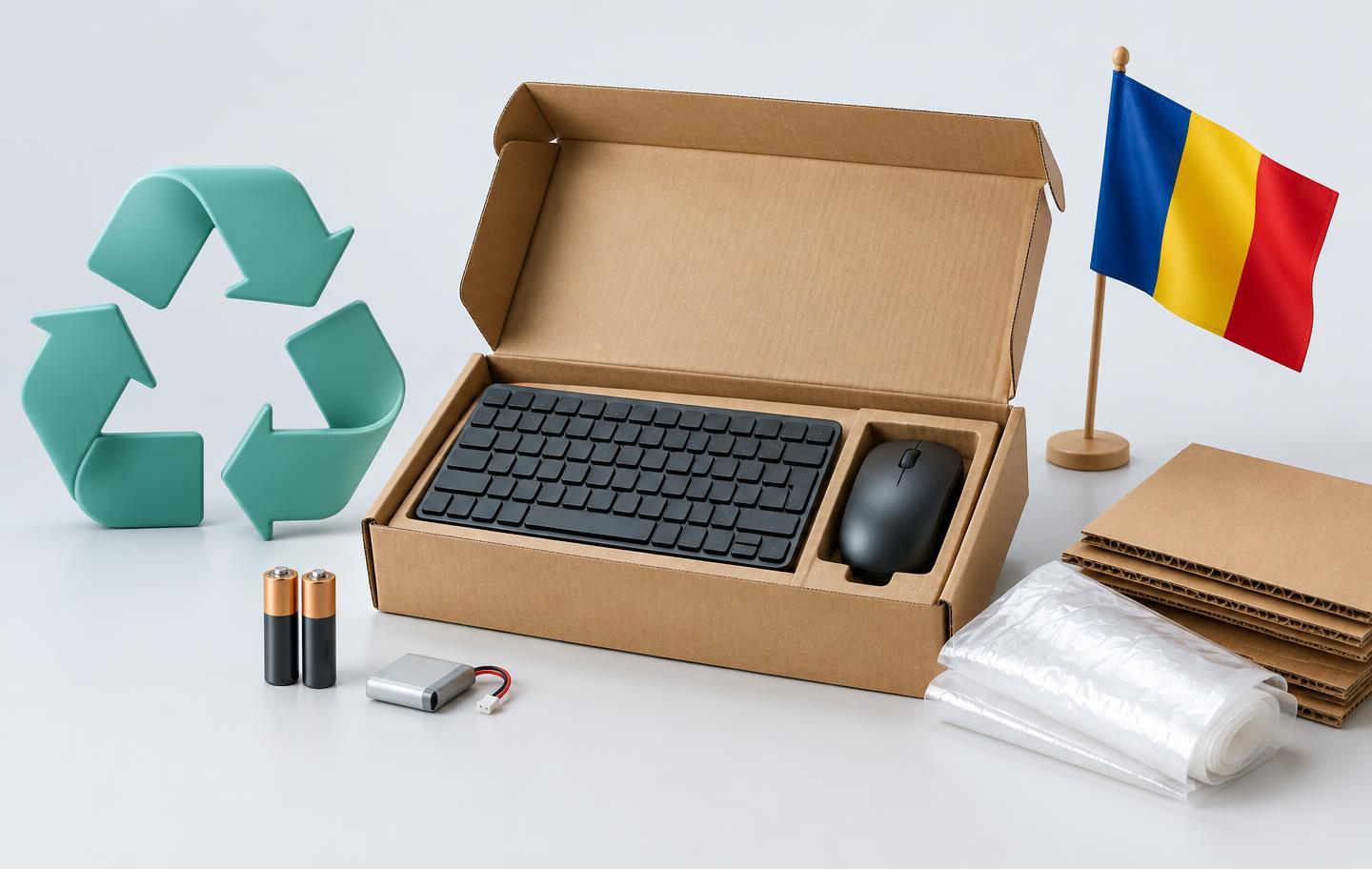
Selling to Romania can trigger environmental obligations even if your company is based in Poland and has no Romanian warehouse. Polish BDO registration, VAT reporting through OSS and a Polish recovery-organisation agreement do not replace obligations for the Romanian market.
The key point: there is no universal registration that automatically covers packaging, batteries and electrical equipment. Assess producer status, the relevant registration or notification, waste financing and reporting for each stream. Packaging also requires attention to the transition to PPWR.
A wireless mouse supplied with a battery in a cardboard box can require three EPR assessments. This guide distinguishes producer-register enrolment from AFM declarations and a producer responsibility organisation contract. The legal overview is dated 12 October 2026.
1. Who is responsible? An EPR producer is not only a factory
An EPR producer can be the first supplier on a national market, an importer, an own-brand business or a distance seller. Definitions differ between packaging, equipment and batteries. Identifying the factory that manufactured the item is not enough.
Direct shipments from Poland to Romanian end users should not be treated as exempt simply because there is no Romanian company. Sales to a Romanian distributor can produce a different result: establish who first supplies the product and the buyer’s role. A B2B invoice alone does not resolve every stream.
Map your supply chain and assess your webstore, marketplaces, wholesale channels and warehouse transfers separately. Tax registration and delivery terms inform the assessment; they do not independently prove EPR compliance.
2. Producer registration, AFM and a PRO: three different processes
A register entry identifies the producer for a particular stream. A producer responsibility organisation (PRO) contract specifies delegated activities such as collection and recycling. Declarations to Administrația Fondului pentru Mediu (AFM) address obligations under Environment Fund rules. None of these documents automatically replaces the others.
For equipment and batteries, check the relevant registers administered by Agenția Națională pentru Mediu și Arii Protejate (ANMAP). Older materials refer to ANPM; the agency’s structure changed in 2025. Do not copy the equipment registration procedure for packaging: confirm national reporting and implementation of the PPWR register separately.
Romanian packaging organisations are often called OIREPs. Check the organisation’s current authorisation, covered stream, reporting period and contractual scope. An authorised-representative mandate and an EPR outsourcing agreement are not necessarily the same document.
3. Packaging: boxes and film matter too
Romanian Law No 249/2015 governs packaging and packaging waste, including responsibility for packaged products placed on the market. Assess sales, grouped and transport packaging: cartons, inserts, film and other components that meet the packaging definition.
If your business is responsible, establish the relevant AFM notifications and declarations, keep material-specific weight records and arrange collection and recycling obligations through a legally permitted model. An OIREP contract must reflect the actual quantities and components for which you are responsible.
Do not report the entire parcel weight as packaging. Use component weights and quantities supplied to the Romanian market. Purchasing empty packaging for stock is not the same as placing it on that market. Certain beverage containers also require a separate assessment of the SGR deposit-return system; an ordinary EPR contract does not settle those requirements.
4. PPWR: registration does not mean one ready-made EU register
Regulation (EU) 2025/40 generally applies from 12 August 2026. Article 44 provides for producer registration in each Member State where packaging or packaged products are first made available, or unpacked without being an end user, within the scope of that provision.
An important detail: the deadline for establishing national registers under Article 44(1) is linked to entry into force of the first implementing act referred to in paragraph 14. The date 12 August 2026 alone therefore does not prove that Romania’s final PPWR registration form is operational. Confirm the transitional procedure and available submission route with the competent authority.
Article 45(3) requires producers covered by Article 3(1)(15)(c) and (d) to appoint an EPR authorised representative when supplying another Member State. This covers specific cross-border supply models, including distance sales. Do not apply the rule to every export invoice without analysing producer status.
The transition to PPWR is not a reason to stop existing reporting. Check the new definitions, representation requirement and Romanian procedure while retaining evidence of compliance with national obligations.
5. Electrical and electronic equipment: a separate WEEE/DEEE entry
OUG No 5/2015 is the principal Romanian act for electrical and electronic equipment waste. DEEE is the Romanian equivalent of WEEE. If your company is a producer under these rules, arrange entry in the relevant national register before placing equipment on the market.
First determine whether the product falls within scope, then identify its category and intended use. Do not restrict the assessment to large appliances: lighting, small electronics, electrical toys and IT equipment can also be covered. Assess exclusions against the legislation, not your shop’s product-category names.
Registration is only the starting point. Collection and treatment financing, reporting, marking and information requirements also matter. Distance sales from another country to Romanian users require attention to a Romanian authorised representative. Verify the written mandate and that registration covers the relevant equipment categories.
6. Batteries: built-in batteries count too
Regulation (EU) 2023/1542 covers batteries, including those incorporated into equipment. A battery-powered toy or rechargeable device still requires a battery EPR assessment. Equipment registration does not replace battery registration.
Chapter VIII on waste battery management applies from 18 August 2025. Article 55 provides for national producer registers and prohibits making batteries available without the relevant registration of the producer or, where applicable, its authorised representative. Romania’s ANMAP publishes information on the RNP B&A register.
Article 56(3) requires an EPR authorised representative for the distance-selling model in Article 3(1)(47)(d) into a country where the producer is not established. This can also cover supplies to other end users, not only consumers.
Identify battery category, weight, chemistry and units rather than using the weight of the complete device. Do not rely only on older Romanian rules or the old three-category division: the current Regulation distinguishes portable, LMT, SLI, industrial and electric vehicle batteries, among others.
7. One wireless mouse — three compliance workstreams
A Polish shop sells a wireless mouse directly to a Romanian customer, includes an AA battery and ships it in an extra carton. The equipment needs a WEEE assessment, the battery needs a battery assessment, and the product box and shipping carton need a packaging assessment. One shop item does not mean one EPR return.
For each stream, establish the responsible entity, registration scope, representative, financing model and reporting data. Buying the device from a Romanian supplier can produce a different result from shipping it from Poland. Obtain evidence for the actual supply chain, not a generic assurance that the supplier “handles EPR”.
8. eMAG, Amazon and your own shop: a platform is not a registration
A marketplace accepting a listing does not prove legal compliance. Warehousing, payment handling or platform fulfilment do not automatically transfer responsibility for equipment, batteries and product packaging.
If a platform offers EPR reporting services, confirm in writing the country, stream, registered entity, representative’s role, reporting and evidence of performance. PPWR includes platform obligations concerning producer compliance information; these do not exempt the seller from its own duties. Assess packaging added by a logistics operator separately.
9. What does it cost and what must be reported?
There is no single official “Romania EPR” tariff for every business. Separate registration, representation, reporting and PRO costs from any AFM liabilities. Costs depend on the stream, category, material, weight and compliance model, among other factors.
Paying AFM is not a universal way to legalise missing registration. Environment Fund rules establish separate liabilities and reporting requirements; a PRO agreement does not automatically remove every declaration duty. Confirm the scope and frequency for your specific role and stream.
Keep records that reconstruct packaging weights by material, equipment by category and batteries by type. Establish how returns, exports and corrections are treated, and retain supporting documents. These records, rather than just the final form, underpin reliable reporting.
10. Checklist before launching Romanian sales
Complete the assessment before placing covered products on the market. If sales have already started, review earlier periods too: a new registration does not automatically resolve historical obligations.
- Map sales channels and identify Romanian end users or distributors.
- Assign producer status separately for packaging, equipment and batteries.
- Confirm the relevant registers and the current packaging procedure during the PPWR transition.
- Appoint an authorised representative where required and obtain a written mandate.
- Check registration scope and PRO authorisations before signing contracts.
- Collect SKU weights and classifications, including built-in batteries and shipping packaging.
- Identify AFM notifications and declarations, other reports, deadlines and responsible people.
- Retain registration confirmations, contracts, reports, corrections and evidence of compliance.
11. Organising the data with EPRPilot
When selling across several markets, the easiest errors to miss are often not registration numbers but differences between streams: a wrong product category, missing battery weight or packaging omitted from a report. EPRPilot helps organise product data, documents and deadlines around a consistent information base.
Confirm support for a specific Romanian registration or report separately. This article does not imply that every Romanian stream is available in every platform package and does not replace an individual legal assessment.
12. Sources and limits of this guide
This guide draws on the Romanian legislation, EU regulations and competent-authority information linked below. Check current amendments, forms and official instructions when implementing compliance, particularly packaging procedures during the PPWR transition and current battery registration processes.
We do not provide unverified registration lead times or a single fee for all products. The precise scope depends on the company’s role, supply channel, product and reporting period.
Können Sie eine Konformitätserklärung in 10 Tagen vorlegen?
Sehen Sie, wie EPRPilot Verpackungsdaten, EPR-Registrierungen und Fristen für alle 27 EU-Märkte an einem Ort bündelt.